
Industrial Refrigeration Maintenance Checklist
A practical industrial refrigeration maintenance checklist for facility managers, operators, and maintenance teams responsible for ammonia, CO₂, cold storage, and process refrigeration systems.
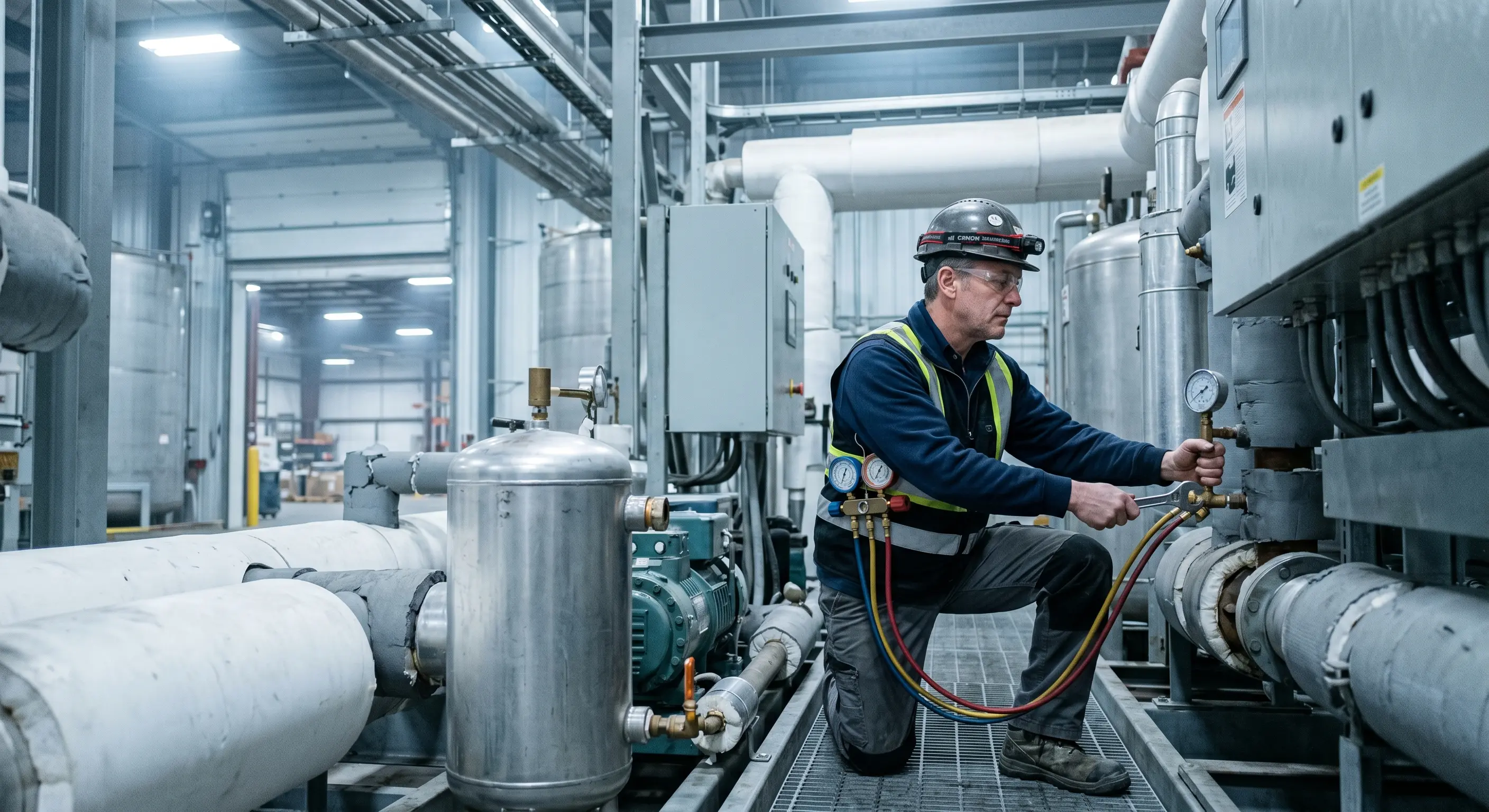
Industrial refrigeration maintenance is not just about keeping equipment running. In cold storage, food manufacturing, ice arenas, breweries, and other temperature-critical facilities, maintenance affects safety, uptime, product quality, energy use, and regulatory readiness.
A good industrial refrigeration maintenance checklist should do more than remind someone to “check the compressor.” It should help operators identify abnormal conditions, document what changed, and make sure the right people respond before small problems become major failures.
This guide outlines the key areas every industrial refrigeration maintenance program should cover. It is not a replacement for manufacturer manuals, site-specific procedures, regulatory requirements, or qualified operator judgment. Instead, it is a practical starting point for reviewing whether your maintenance program is covering the right categories.
For facilities that need help building or improving a refrigeration maintenance plan, Enns provides preventative maintenance agreements, refrigeration operator services, troubleshooting, and full industrial refrigeration services.
Why Do You Need an Industrial Refrigeration Maintenance Checklist?
Industrial refrigeration systems are mechanical, electrical, and control systems working together under demanding conditions. Compressors, pumps, evaporators, condensers, gas coolers, controls, valves, piping, oil systems, and safety devices all need to function as intended.
A checklist helps maintenance teams stay consistent. It also helps facility managers confirm that important observations are being logged, reviewed, and acted on.
For ammonia refrigeration systems, the EPA ammonia refrigeration manual states that mechanical integrity procedures must be written and implemented to maintain the ongoing integrity of process equipment. It also states that a preventative maintenance program and schedule should be based on manufacturer recommendations and recognized and generally accepted good engineering practices for each refrigeration system component.
That point matters: a checklist should not be generic. It should be built around the actual system, refrigerant, equipment, operating conditions, and applicable requirements at the facility.
What Should Be on an Industrial Refrigeration Maintenance Checklist?
An industrial refrigeration maintenance checklist should be built around the actual equipment, refrigerant, operating conditions, and facility requirements. A cold storage warehouse, food manufacturing plant, brewery, arena, and process refrigeration system may all need different inspection points, but the core categories are often similar.
The following sections outline the main areas facility teams should review when building or updating an industrial refrigeration maintenance checklist. Use them as a practical starting point, then confirm the final checklist against your equipment manuals, site procedures, and applicable regulatory requirements.
1. Daily or Shift-Based Operating Checks
Daily operating checks create the baseline for understanding how a refrigeration system behaves under normal conditions. Without consistent readings, it becomes harder to tell whether a pressure change, temperature drift, or oil issue is part of normal operation or an early sign of a developing fault.
The EPA ammonia refrigeration manual notes that many facilities use a daily engine or compressor room log to record process temperatures, volumes, vibration, lubrication levels, and pressures at least once per operating shift. It also states that startup, shutdown, pump-down operations, and the results of work or testing should be recorded in the daily log.
At a minimum, daily or shift-based checks should capture the operating conditions that matter most to the system: suction and discharge pressures, oil pressure, oil levels, room or process temperatures, compressor status, pump status, alarm history, and any unusual noise, odour, or vibration. These readings should be reviewed as a pattern, not as isolated numbers. A single reading may not tell the full story, but a trend in pressure, temperature, oil pressure, or equipment behaviour can indicate that the system needs attention.
This is especially important in facilities where refrigeration downtime can affect product temperature, production schedules, or customer commitments. When internal staff cannot provide consistent coverage, Enns supports facilities with refrigeration operator services and preventative maintenance agreements.
2. Compressor and Rotating Equipment Checks
Compressors, pumps, and other rotating equipment deserve close attention because mechanical problems often appear gradually before they become failures. Changes in vibration, oil pressure, motor behaviour, temperature, or loading patterns can all provide useful warning signs.
A compressor check should look beyond whether the machine is running. Operators should note how it is running. Is oil pressure stable? Is the compressor loading and unloading normally? Are vibration levels changing? Are there repeated shutdowns or nuisance alarms? Has the compressor accumulated enough run hours to trigger a planned inspection or service interval?
The EPA manual notes that some facilities use vibration testing on rotating equipment such as compressors and pumps to supplement maintenance practices. It states that vibration levels can be logged and analyzed to determine whether abnormal trends are developing or whether further inspections are warranted.
When abnormal vibration, repeated oil issues, or recurring compressor shutdowns appear, the next step should be a structured investigation rather than repeated resets. Enns provides vibration analysis, compressor rebuilds, and industrial refrigeration troubleshooting for facilities dealing with compressor reliability problems. For more detail on the repair side, read more about compressor overhauling.
3. Piping, Insulation, and Corrosion Checks
Piping and insulation problems can be easy to overlook because they often develop slowly. Damaged insulation, failed vapour barrier, ice buildup, rust, corrosion, oil staining, or unsupported piping should all be treated as maintenance findings, not cosmetic issues.
The EPA manual states that refrigeration piping should be periodically inspected for failed insulation or vapour barrier, rust, and corrosion. It also states that ammonia piping beneath failed insulation should be carefully inspected.
In practice, this means operators should pay attention to areas where moisture can collect or where piping is hidden by insulation. A damaged vapour barrier can allow moisture into the insulation system, making corrosion harder to see until insulation is removed. Pipe supports, penetrations, valve stations, and low points are also worth checking closely because they are common places for wear, moisture, or movement-related issues to appear.
If piping, insulation, layout, or recurring performance issues suggest that the system needs more than routine service, Enns can support system design, refrigerant retrofit, and industrial refrigeration installations.
4. Labels, Valve Identification, and Signage
A maintenance checklist should include labels and signage because clear identification reduces confusion during operation, service, and emergency response. This is especially important in industrial refrigeration plants with multiple compressors, vessels, evaporators, valves, and control points.
The EPA manual states that colour-coding and/or labelling systems help keep engineering drawings and piping and instrumentation diagrams current and reduce the chance of errors in operating procedures. It also recommends identifying the physical state of the refrigerant, pressure level, ammonia flow direction, and emergency isolation valves.
Instead of treating labels as a once-and-done item, facility teams should check whether pipe labels are still readable, valve tags still match the drawings, flow arrows are visible, and emergency isolation valves can be identified quickly. Labels that are missing, faded, damaged, or inconsistent with the P&IDs can slow down troubleshooting and increase the chance of mistakes.
The EPA manual states that facilities lacking clear and comprehensive labelling are “accidents waiting to happen.” For facilities reviewing ammonia-related risk, read more about ammonia leaks or Enns’ ammonia refrigeration services.
5. Leak Detection and Refrigerant-Related Checks
Leak-related checks should be part of routine maintenance, but the details depend on the refrigerant and system design. Ammonia and CO₂ systems have different hazards, pressures, detection methods, and response procedures, so the checklist must be refrigerant-specific.
For ammonia systems, the EPA manual states that operators, maintenance personnel, and other facility workers should be encouraged to immediately report ammonia odours. It also states that facilities should immediately investigate all reports of ammonia leaks and take corrective actions without delay.
A practical leak-related review should include detector status, alarm history, ventilation status, refrigerant inventory changes, recent refrigerant additions, relief valve discharge history, and visible evidence such as staining or frost patterns. Reports of odour should never be dismissed without investigation.
For CO₂ systems, the checklist should reflect the higher-pressure characteristics of the system and the manufacturer’s service requirements. A CO₂ transcritical training manual includes leak testing with a CO₂ sniffer-type tool as part of after-startup maintenance.
Facilities using natural refrigerants can read more about Enns’ ammonia refrigeration and CO₂ refrigeration services, or review this overview of CO₂ refrigeration.
6. Controls, Sensors, and Automation Checks
Controls are often where refrigeration issues first become visible. A sensor that is out of calibration, a misunderstood control sequence, or a poorly adjusted setpoint can create performance problems that look mechanical but begin in the control system.
A CO₂ transcritical training manual states that, after startup, temperature sensors and pressure sensors should be well calibrated, programming should be finished and understood by the servicing contractor, and control panels should be closed.
For maintenance purposes, controls should be reviewed in terms of both accuracy and intent. The team should know whether temperature and pressure sensors are reading correctly, whether alarms are meaningful, whether defrost schedules match operating needs, and whether recent programming changes were documented. Control panels should also be maintained in a condition that supports safe operation and troubleshooting.
When a system has recurring alarms, unstable operation, or performance that changes after control adjustments, the issue may require specialized review. Enns provides specialized automation and troubleshooting support for industrial refrigeration systems.
7. Defrost System Checks
Defrost performance affects coil efficiency, product temperature, room recovery, and energy use. A defrost cycle that is too short may leave ice on the coil. A defrost cycle that is too long may add unnecessary heat to the refrigerated space and increase system load.
A CO₂ transcritical training manual states that defrost lengths and pressures should be verified to ensure energy consumption is minimized. It also states that, after defrost, the evaporator should exceed 32°F and the coil should be clear.
In an operating facility, defrost checks should consider more than whether the defrost cycle started. Operators should look at whether the coil actually clears, whether the drain pan and drain line are working, whether the room recovers properly afterward, and whether ice returns quickly in the same area. Repeated ice buildup may indicate that the defrost schedule, airflow, drain condition, door activity, or operating conditions need review.
This is particularly important in cold storage, food manufacturing, and ice arena refrigeration, where temperature stability directly affects facility operations.
8. Emergency Response and Safety Equipment Checks
Emergency readiness should be part of the maintenance program, not a separate binder that only gets opened during audits. If emergency equipment is missing, inaccessible, expired, or poorly understood, the facility may lose valuable time during an incident.
The EPA manual states that an emergency response program must include procedures for inspecting, testing, and maintaining emergency response equipment. It also states that emergency equipment should be inspected and tested regularly so respirators and other equipment are maintained, available, and accessible.
The checklist should confirm that emergency contact information is current, emergency equipment is accessible, required inspections are documented, employees understand reporting procedures, and emergency shutdown access is unobstructed. For ammonia systems, the EPA manual also states that response actions during the first few minutes of a release are the most critical and should be planned and rehearsed.
Facilities in Ontario can read more about TSSA refrigeration regulations in Ontario and refrigeration operator coverage in Ontario.
9. Maintenance Records and Logbooks
Documentation is what turns maintenance from a series of isolated tasks into a usable history of the system. Good records help operators understand what changed, when it changed, who performed the work, and whether a problem is recurring.
For Ontario-registered plants, the Operating Engineers Regulation states that records must be kept of matters that may affect the safe management, operation, and maintenance of the plant. The same regulation states that logbooks must be kept accessible in the plant for at least three years after the date of the last entry and must be produced for examination if requested by an inspector.
Useful records may include operating logs, alarm logs, work orders, compressor run hours, refrigerant additions, leak investigations, inspection reports, control changes, oil service records, vibration readings, and emergency equipment inspections. The goal is not paperwork for its own sake. The goal is to create a record that helps the facility make better decisions.
For facilities that want a more structured approach, Enns provides preventative agreements and supports long-term maintenance planning through industrial refrigeration service contracts.
Sample Industrial Refrigeration Maintenance Checklist
The checklist below is a general starting point. It should be reviewed against the facility’s equipment manuals, site-specific procedures, refrigerant type, operating requirements, and applicable regulations before use.
When to Call an Industrial Refrigeration Contractor
Facility operators should consider bringing in a qualified industrial refrigeration contractor when they see repeated alarms, abnormal pressure or temperature trends, recurring oil issues, unusual compressor vibration, unexplained refrigerant losses, persistent defrost problems, control instability, or recurring emergency service calls.
Enns Industrial Refrigeration supports facilities across Ontario with:
- Ammonia refrigeration
- CO₂ refrigeration
- Cold storage refrigeration
- Compressor rebuilds
- Preventative agreements
- Refrigeration operator services
- Troubleshooting
- Vibration analysis
- System design
- Refrigerant retrofits
Whether you operate a cold storage facility, food manufacturing plant, brewery, process refrigeration system, or arena, a structured maintenance program helps protect uptime and gives your team a clearer picture of system health.
To discuss maintenance support, contact Enns Industrial Refrigeration through the contact page.
Frequently Asked Questions (FAQs) about Industrial Refrigeration Maintenance Checklists
What should be included in an industrial refrigeration maintenance checklist?
An industrial refrigeration maintenance checklist should include operating logs, pressure and temperature readings, compressor checks, oil checks, piping and insulation inspections, leak detection review, labelling checks, defrost performance, emergency equipment checks, and maintenance records. The exact checklist should be based on the specific system, refrigerant, manufacturer requirements, and applicable regulations.
How often should industrial refrigeration systems be checked?
The provided EPA ammonia refrigeration manual supports recording key operating conditions at least once per operating shift for many facilities using daily compressor room logs. Specific inspection and maintenance frequencies beyond that should be based on manufacturer recommendations, recognized good engineering practices, site procedures, and applicable requirements.
Does automated monitoring replace operator rounds?
No. Automated monitoring can help track and alarm system conditions, but it should not be treated as a replacement for qualified operator review, field observations, and maintenance procedures. The provided EPA manual states that logs should be reviewed for trends that may indicate system problems.
What are signs that an industrial refrigeration system needs service?
Warning signs may include increasing pressures or temperatures, decreasing oil pressure, abnormal vibration, unusual noise, unexplained alarms, repeated resets, poor defrost performance, refrigerant odours, visible corrosion, damaged insulation, or repeated equipment shutdowns.
Who can help build a refrigeration maintenance checklist?
A qualified industrial refrigeration contractor can help review system equipment, operating conditions, manufacturer requirements, and service history. Enns provides preventative agreements, refrigeration operator services, and troubleshooting for facilities that need a more structured maintenance program.
Industrial Refrigeration Experts
Trusted by some of Ontario’s finest for over 20 years.
Speak With a Technician Today
.webp)